Thursday, April 16, 2026

We call them Rainbow Gatherings (guest post)

 Today's guest post comes from Carla

We call them Rainbow Gatherings, not Rainbow Festivals, for good reason. Here’s why. 

I suppose new folks have noticed by now that regular gatherers are very picky about word choices. Take, for example, the term “festival.” If someone calls the gathering “The Rainbow Festival,” they usually get jumped on and corrected, sometimes quite rudely, and almost always without explanation. So I will attempt to explain. 

Technically, the gathering does fall under the general definition of a “festival,” which in many countries means a local community-wide religious or cultural observance.

However, in the U.S., “festival” has a very specific meaning, and it has nothing to do with local tradition. “Festivals” here are highly commercial, usually focused around several-day music or themed events. There are ticket sales and entry gates and lots of vendors selling food, drink, and merch. The people attending go as passive observers, and have a wonderful time partying. Nothing wrong with that. Folks come from all over, and bask in the music. These kinds of festivals are good for the heart and the spirit, without question. 

So what makes the gathering different, and why does it matter? 

The gatherings, first of all, are peaceable assembly in its purest form. There is no corporation running them. No board of directors. No by-laws. No fees. No entry gates. No merch. No vendors. And most importantly, no hired cooks or janitors or cops, no porters or butlers or maids, no mayor or chair person. 

The gatherings—every inch, every act, every system—are all done by the people who gather together. For free. 

How is this possible? Well, it isn’t, any reasonable person would conclude. But somehow, we’ve been doing it for 52 years now. I’ve been gathering since 1979, and have been involved in most aspects of the temporary infrastructure and systems and processes that create the gathering itself. I am still blown away that it works. Ten thousand people, or more, doing it on their own? Impossible. 

But we do it.

So how does it work? 

Each one of us, individually, finds something they are good at, or love doing, or want to learn, and does it. That includes buying and carrying supplies, cooking, sanitation, fire watch, participating in talking and decision making circles, and a million other tasks that make the gathering happen. 

The best way to enjoy a gathering is not to sit by a campfire and play music 100% of the time, although that is okay and no one will bother you if you do that. But if you really want to experience a gathering fully, become part of this amazing phenomenon, pitch in. Plug in. Get involved. You will quickly form bonds and find community. 

The most important service anyone can provide to the gathering as a whole, without actively pitching in any other way, is to maintain awareness of trash. Keep the scene clean. Haul out every single piece of everything you  bring in, including garbage. 

The folks doing cleanup and site restoration are our own family, not the Forest Service, not someone hired. And it is daunting, hard work. Please be respectful of both the land and the folks staying for this. Don’t burden them with broken lawn chairs, jars of pee, or partly disassembled kitchens or camps. Undo yourself what you have done. Disappear it all. 

If you want to get involved and form bonds, though, find the folks who are doing what you would like to be doing. Then introduce yourself. 

The four most important four words for entry into any kitchen, camp, or gathering system is: 

How can I help?

Monday, April 13, 2026

Gathering with Kidz by Info Karen (Guest Post)

  My good friend, Info Karen, put together today's guest blog post -- not to confuse anyone but there are two of us living in San Diego. Karen with an "E" and me - Karin with an "I". Since Info Karen has kids, she graciously agreed to put together today's guest post for those of you coming home with kids. If this helped you, please stop by Info when you're at the gathering and thank her.


Bringing babies and small children to the Rainbow Gathering can be quite a chore, but it is also very rewarding, and a wonderful growth experience for them. But deep woods camping with your kids can be quite a challenge. Being a Rainbow Mom myself, I was asked, a few years back to pass along some helpful advice for folks who are bringing their kids for the very first time. The following article sprang from those requests. I wrote it when my eldest was 6 and my twin boys were three and potty-training. I’ve been to the annual Gathering with my first when he was an infant and when he was 3, and then brought all three of them many times after that. This is especially directed at first time Gatherers since a few requests of this type have come my way, but there is lots of good advice for anyone with kids. Do you have more ideas? Please add them in the comment section.

*********************

ARRIVAL AND HIKING IN:When you first arrive at the Gathering, you will be directed to a meadow to park in, (or perhaps along a road). Hiking in with kids often takes a couple loads, so having a partner who can either hang with kids or go get the second load is a huge help. Get a baby carrier of some sort to carry your littlest ones in. On the first trip into the site, we tend to bring the kids, the tent and our plates, cups and utensils in the first load, plus whatever else we can manage. We each will wear a kid on our backs (we have twins). After figuring out where we want to camp, I will stay at the tent site with all three kids while the hubby goes out for another full load. While he is gone I will put the tent up, and perhaps go exploring with the kids to find a meal, fill our water bottles, and locate the nearest shitter.
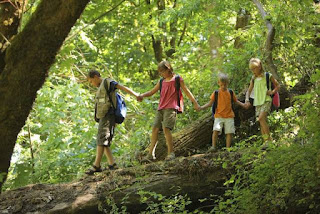

KID VILLAGE:You can camp anywhere with kids, but it is especially nice to camp at Kid Village. It is a drug-free, peaceful area that serves three good kid-friendly meals every day. Kid Village is easy to find. Ask anyone. When you get to Kid Village ask the folks there where there are some good tent spots. They will direct you. At Kid Village, they usually have a little play area with seesaws and swings made from downed trees and rope. There is also usually a sit-down potty there (people just call toilet areas "shitters" so sorry if your child goes home spouting that word!! For adults, shitters are long trenches that you straddle. It’s nice to wear skirts if you want to have a little privacy cover!) Often for little children there are small deep cylindrical holes dug so that the kids don’t have to balance across a trench.

DAILY LIFE:You will want to bring, for each of you, a water bottle, a dish, a spoon, a cup and a day pack to carry everything in while you are away from your tent. If you drink coffee, make your cup a thermal one with a lid. If you can, put a carabineer on your cup as it’s nice to always have it hanging from your belt. Each morning, you will want to pack your daypack for the day and go out wandering. You may head back to the tent for naptime, but you will want to take your dishes, your water bottle, and whatever diapers or things you need for the day with you when you leave your tent in the morning. For dishes, most people bring just a bowl. But after many years of gathering, I have discovered that the very best bowl is a tupperware or similar style container with a lid. This way, if you can't get to a dishwashing station right away after you eat, you can pop the lid on it and toss it in your bag without dirtying anything inside your bag. We found plate-shaped containers with three divided sections which is nice if you get soup and something else. It keeps them divided. Plates with lids are also good for bringing food back kids, or storing things they might not eat right away.

DIAPERS: If you use disposable diapers, I would bring a double thick bag (one inside the other, to lessen the smell and strengthen the bag) with some kind of clasp that can be put on and taken off numerous times, to keep your dirties in. You will need to hike this (very) heavy bag out at the end, as there are no trash stations inside the gathering. Everyone carries their own trash out. Depending on how long you stay, a full bag of dirty diapers can be one whole load! With twins, and ten days in, our bag was large and difficult to manage. If you use cloth diapers, I have seen people wash them out in five gallon buckets and hang them on clotheslines hung between trees. You can get a 5 Gallon bucket for about 3 bucks at large hardware stores. Bring your own clothesline as well. Kid Village has had a communal diaper wash area in the past but I don’t think it is a regular thing at all.

FINDING FOOD / DINNER CIRCLE:At Rainbow the food that is cooked in the kitchens is free for all, and is purchased with donations to the Magic Hat that lives on the desk at the Information Booth, and is also carried around every evening at Dinner Circle in a musical parade. Dinner circle happens every evening in the Main Meadow. Most larger kitchens will bring their cooked food down to the dinner circle and serve there. Bring your dishes! People form a large circle, do a group “Om”, and sit down in circle to be served by the food servers. Pregnant or nursing Mamas and children (and non-parents helping children) are asked to come to the center of the circle before the food is served to get first dibs. Don’t be shy. Come forward when it is announced and get your kid a plateful of good food! Breakfast and lunch are often served out of individual kitchens. Kid Village is a good place to find steady outpouring of food, and if your kid misses a meal, they can direct you to fixings for a peanut butter sandwich or a carrot or something. That said, most people like to bring snacks from home to keep in their tent to keep the kids happy. Dried fruit, nut butters, jerkey and granola are things many people tend to bring.

NAPS: For small babies, it’s not common, but I have seen people bring a playpen and hike it in. That way you can set the baby down somewhere clean for a while. You might consider bringing one and leaving it in the car. Then you can decide if you want to hike it in or not. A lightweight baby floor chair might be a simpler idea, or perhaps a Moses basket? When I brought my first born to his first gathering at about seven months old, I put a blanket in a cardboard box I got from a kitchen! Having walls is nice for a new crawler. A good ground-blanket made out of something with a water resistant bottom layer is nice to have. After realizing the cardboard box was nice to have but not the best choice, the next time I brought a kid’s pop-up backyard play tent. They pack down tiny and can be used to lay the baby down to sleep if you are out wandering away from your camp and want to take a break, or give him/her some shade to rest in. We also napped our eldest in that for a couple years. It was handy, and kept us from having to go and sit quietly outside our own tent for 3 hours every single day. We used to nap our twins separately during the afternoon, because if they napped together, they would just play in the tent and not sleep.

NECESSITIES:You should have water bottles you can carry around for your family. You can fill them up at any kitchen. Look for a giant cooler on the kitchen counter with a spigot facing out toward the public walk-up area. Bring sun block, wide brimmed children’s hats, bug spray and sun glasses. We are bringing those new 200 hour LED flashlights for our littlest boys who will of course want to have one of their own when they see ours. They can accidentally leave it on for hours and it won’t use up the batteries. Sandals that can get wet or water shoes are great for playing in the stream. When the twins were three years old, and liked to wander, we brought masking tape and stuck some on the backs of their shirts saying “IF FOUND PLEASE RETURN TO INFO” where we were camped! When the kids got older we made sure each kid had his own daypack to keep track of his things.

TENT SLEEPING: Also bring warm sleeping bags. It gets down to 40 at night. We always bring thermal underwear to sleep in, both for us and for them. When our son was a baby, and we worried about the safety of sleeping bags, we slept him in a down-filled, winter outdoor snow suit, wearing a hat, with a regular blanket over him. That way I wasn't worried about losing him down inside the sleeping bag or about him scooting out into the cold at night. Beware of using any kind of gas heater inside your tent as the fumes inside a closed tent can be deadly.

NURSING BABIES:Another idea I has which turned out to be SUCH A GOOD IDEA, was my homemade nursing shirts. While still at home, I got a couple long-sleeved thermal shirts at the thrift store. I cut vertical slits in the front for nursing, and when I was at the Gathering I would wear these shirts underneath my regular shirt. The benefit is that on cold days, and ESPECIALLY on cold nights, I could lift my outer shirt to nurse without having to expose the sides of my torso to chill air. It was SO much warmer, and easier to doze when nursing in the middle of the night half out of a sleeping bag! These shirts might not be so necessary for eastern Gatherings, but most western Gatherings can get pretty cold at night.

COMMUNICATION FOR OLDER KIDS:As our kids got older, and wanted to go off and explore on their own, we went out and got a good set of FRS radios, one for each of us, and some extra batteries. These are fairly long range radios. For the kids we put them on lanyards and hung them around their necks, and sometimes they put them in their daypacks (although they sometimes would miss our calls if they did this). A belt loop holster would be a good choice as well. This way, if they want to stay out longer, or ask a question, they can reach you and it gives them some more freedom, and the parents some freedom as well! (Also, they are good for letting the other party know that pizza is just coming out of the Ovens and that you should hurry on over!)

LASTLY:Have a blast! It’s a great way to immerse your kids in wild nature! -Info Karen- (Mom to three exuberant boys) Please comment below with any questions or great ideas or parent-hacks of your own! Please comment below with any questions or great ideas or parent-hacks of your own!

There is also a Kidz Rap available on-line.

Saturday, April 11, 2026

Kidz Rap

 Kidz Rap

The Rainbow Path to Responsible Parenting
or: The Rainbow Path to Child Safety

Welcome to the Gathering. This is a wonderful space to be in. It feels very free and safe. We want to maintain that feeling, yet at the same time it is necessary to be sensible in order to keep our children safe and healthy.

As times change, society in general has developed more problems and illnesses. Some of these, unfortunately, can carry over into our safe haven here. To ignore these problems is not sensible. They do exist, therefore we as a family must take measures to prevent them.

Here are some helpful ideas that work, and we strongly suggest you take them to heart for the sake of all our precious children . . .

Please keep track of your children. Know where they are and when they should be back to your camp sites or meet you.

If someone else is caring for your children please make sure you really know who that person is and that you have spent time with that person. Sometimes, unfortunately, those persons who would harm our children have a facade that “feels OK” and a very trusting pleasant personality. This is not to say don’t trust your feelings or other people, please, just take some time and extra care -- our children deserve it.

Don’t just drop your kids off at Kid Village and leave. Become part of the scene. Get to know the other parents. If someone agrees to watch your children while you go off and enjoy some personal time, let them know where you are likely to be found, and when you will return. Make contingency plans in case you are delayed and/or they must leave Kid Village, so you know where your child will be and who they will be left with.

Older children need to know how to find their “home camp” and parents. They also should be shown safe areas (Kid Village, Info Centers, kitchens,) to go to if they are in trouble, lost, or hurt. They should know how to describe you and your camp area verbally. For younger children who cannot talk well and might wander off, use tags -- pin a piece of paper to their backs (so they can't pull it off) with their name, your name, and directions to your camp. Use safety pins or tape.

If your child gets separated from you or lost, please don’t wait long to act. If after a search for your child in the immediate area they are still lost, immediately find a person with a radio and tell them your child is missing and you need help. This needs to happen quickly so we can do the best job, especially if it is close to nightfall. Better safe than sorry.

We are all responsible for our children. If you notice anything that looks or feels “not quite right” or a child that looks distressed or frightened, please don’t look the other way. It's better to check it out than to let a tragedy occur. As parents, please keep in mind that if someone cares enough to interfere and asks questions about your child or your parenting that it is coming from the heart and is meant in the interest of all our children's best welfare. Please try to be understanding.


Thursday, April 9, 2026

Pennsylvania Gathering 2010

 Enjoy this video from the 2010 gathering centered on NERF Camp (New England Rainbow Family)

I have been promised that everyone in the video agreed to be in the video and to have it shared.


Monday, April 6, 2026

Avoiding citations at the gathering

How to get a citation  

Every year the United States Forest Service Law Enforcement (USFS) Incident Management Team (the cops) attempts to write as many tickets to family coming home as they possibly can to justify their presence. 

They give out tickets for broken tail lights, failure to use a turn signal in a deserted parking lot at 2 AM, lack of seat belts, controlled substances (even just a trace amount), beads hanging from your rear view mirrors, prescription medications if the label doesn't clearly have your name on it and you can't prove who you are, dogs off leash, a vehicle missing a front license plate even if you live in a state that does not issue a front license plate and a lot more violations of the letter of the law. In 2025, they wrote tickets for being at an "illegal event." Never admit you are going to the Rainbow Gathering.

However, these tickets are not the type of citation you would probably receive for any of these issues in your hometown. 
 
If you receive a citation on the way into the gathering or at the gathering, please stop by INFO at the Gathering as we are trying to organize support for ticket holders. Details to be discussed on the land.

What happens next? 

We don't know what will happen in 2026 yet. But in the last few years there have been a few patterns of how the legal system addresses gathering related citations, no matter if it is for a broken tail light or an ounce of weed.


1) Kangaroo court

These are Federal mandatory court appearance tickets. There will be special court dates set up just for us during the gathering or shortly thereafter. These are usually held near the gathering, or at a local courthouse, fire station or visitors center and go before a magistrate. Or sometimes we got to a courthouse 100 miles away. In the past, charges have been reduced, fines were often minimal and the court has allowed people to make payment plans that could grant you 90 days to pay $200.

Court dates will be written on the citation. This is the best case to have your fines significantly reduced. If you miss your court date, the USFS LEOs will come into the gathering looking for you. If they find you they will arrest you and put you in jail until the next court date. If this happens on a Friday afternoon, you will be in jail until Monday 

2) Pay Online

In California 2024, there was on online payment system that you could use to pay your ticket online or go to court on the date assigned to you months after the gathering. It took a few months before peoples' tickets appeared in the system, but once there you had the option to pay Collateral forfeiture. This is a legal process that allows individuals charged with certain petty offenses to pay a specified amount of money to the government instead of appearing in court, effectively resolving the case without a conviction being recorded. 

CVB website and additional information.

Sample generic federal ticket info

In this model, as long as you pay your ticket before the scheduled court date, you do not need to appear at your arraignment to avoid a Federal Warrant as long as you pay the ticket a few days in advance. Don't wait until the last minute as courts move slowly and you don't want to pay the ticket the day before, the court may not be aware, and then you will get a Federal Warrant.

3) Mandatory court appearance months after the gathering 

These are Federal mandatory court appearance tickets that require you to appear in a Federal Courthouse (typically in the State's Capital) a few months after the gathering is over. This happened in Missouri 2025. People were not allowed to pay their tickets online. Everyone had to travel to Springfield Missouri in October and plead no contest or not guilty. The information I received from those who went through the process was that the court was not prepared for this nor did they know anything about it until 1-2 weeks ahead of time. 


All Citations

If you do not pay your citation using whichever method 2026 brings, a Federal Warrant will be issued for your arrest. The next time a law enforcement officer for any reason stops you, your ID will be run through the database and you will go directly to jail.
 
Of course, everyone is free to manage this situation as they wish but I strongly recommend you go to your court date. I have seen people charged with crimes that could potentially result in a six years' prison time walk out with a $500 fine and three years’ probation. Keep in mind that every year the dynamic is different and these results may not always be available. Sometimes there are lawyers and other experienced family at the gathering (I am not a legal expert) who attend the court dates and will assist as best they can although I recommend you catch up with them before your court date to gain a better understanding of your specific charges and strategies to get the charges dropped or reduced. If you do not know these people personally, go to INFO and let them know you received one of the magic tickets and you need legal assistance.
 
FYI:  Federal law trumps state law on weed. This means that WEED IS NOT LEGAL IN NEW YORK OR PENNSYLVANIA NATIONAL FORESTS.  This applies to any reason for having weed, medical or not as the Federal Government has draconian marijuana laws. The LEOs will try to trick you to admitting that you have weed. Don't fall for it.  
 
Start today by making sure your car and driver are 100% legal, you do not smoke anything in your car that is not legal under federal law (even if the state has legalized weed) as at the gathering, federal laws apply. Don't let yourself get tricked. If they smell it, they can pull you over. When you drive within 25 miles of the gathering, drive like you are taking a driving test. Signal ahead of time, drive below the speed limit, make sure all riders have seat belts and all children are in an age-appropriate car seat. 
 
Some people will say I'm making this up or being paranoid. If you don't believe me, talk to other long-time gatherers and confirm what I am saying. 

Before you enter the national forest, pull into a legal parking space and test that all your lights are still working correctly. Play the game and you can glide into the gathering trouble free and spend your time chopping firewood and hauling water instead of going to court.  The choice is yours. 


Thursday, April 2, 2026

On Changes, Expectations, and Problems (Guest Post)

Today's guest post comes from a friend who sometimes goes by Scott Sowka but you may know him by other names as well.  I would add that the more you put into this family, the more you get out you can't see the rainbow if you don't have rain!

**************BEGIN GUEST POST********************

I have a lot of sympathy for what B....  was feeling in the OP. Sometimes, being the resident adult can stretch a person thin and drain the tanks. Definitely been there on more than one occasion. Having said that, ... I'm going to push an alternate rap here.

Gatherings aren't safe. They aren't fun. They never have been. Their purpose was never to be an escape with your friends, and their reality has always been less than ideal. If you were under the false impression that they were those things, it was because you were caught up in the magic, temporarily blinded by the mind-blowing experience of existing in a real community built on unconditional love, and coddled by our elders, who selflessly worked behind the scenes to craft the culture. The truth is, there have always been cops, violent people, alcohol, drama, root fires, bad sanitation, and every other problem under the sun. Always.

There are only two major things that are changing, and they are related. The first is that the torch is being passed down. Our founders are dying, or getting too sick to come home. The wizards who used to weave the magic and keep the bullshit bound can no longer do so. The other thing that's changing is your perception. The magic isn't so magical to the person fueling it with their sweat and tears. You are seeing behind the curtain, becoming a wizard yourself. It is not an easy task. Often, it's not a pleasant task, but it is rewarding.

I don't ever go to a gathering expecting it to be something. I go there expecting to make something out of the chaos. That's meant being in danger, breaking up fights, putting out fires, cleaning up other people's messes, dealing with ego and entitlement, and a bunch of other unsavory stuff. Why go then? The moment where the schwilly kid gets sober, when the meek girl escapes her abuser, when the new kid cooks circle, when the 6up carries a water run, when the barefoot bliss ninny builds public shelters in the snow. Everyone is welcome because the lowliest and least likely to be invited are the ones who need us most. We are culture crafting and teaching lessons that have been carried out into Babylon for decades. It's important, and I don't intend to let my personal hardships dissuade my participation.

Here's my advice to those of you who are not getting the experience you desire, and it's the exact same advice that the problem children need to grok... Don't come to Rainbow for what you can get out of it. Come for what you intend to put into it. Not only will that help to fix the problems you are seeing, it will also ensure that you'll leave feeling satisfied, even when it's one of those gatherings that takes every ounce of your magic and still seems to be a shit show.

Saturday, March 28, 2026

The First-Timer’s Practical Guide to the Rainbow Gathering (Guest Post)

Today's guest post comes to us from The Other Karen who lives in San Diego and is one of the regulars who plugs in at INFO each year. If you like this post, she has a blog called What Is The Rainbow Gathering. Visit it for more great information. Enjoy! 

The First-Timer’s Practical Guide to the Rainbow Gathering


What is the Rainbow Gathering?
               
                The Rainbow Gathering is an annual free event that happens every summer on and around the week of the 4th of July on public land in a different National Forest, in the United States of America. These Gatherings have gone on each year since the first in 1972. Since then, numerous regional and international Gatherings regularly occur in American states and in different countries around the globe.


When is the Rainbow Gathering?

                The original annual Rainbow Gathering in the United States takes place officially from July 1-7 every summer, every year. There are American regional Gatherings and International Gatherings that take place other times during the year. That said, many people arrive 2 or 3 weeks ahead of the annual Gathering and set up infrastructure… assign places for Main Meadow, the Parking Lot, Kid Village, the Info Booth, they tap the natural water springs and run water lines, mark trails and dig the first latrines. This period of time is called SEED CAMP.

                After July 7th, CLEAN UP CAMP begins and anyone who remains is expected to participate in cleaning up the Gathering site, to participate in Vision Council (which decides in what region next year’s Gathering will be), or in cooking food for people who are doing those other two things. The idea is help out or move on.

                The focal point of the July 1-7th week is the 4th of July, often called Inter-dependence Day. On this day everyone in camp wakes in Silence and goes about their morning tasks in meditative silence, thinking on the idea of PEACE in this world. When ready, each individual comes to the MAIN MEADOW and joins the others there in silent prayer ormeditation or quiet thought and focus on World Peace.

                In Kid Village, the children (not in silence) eat and prepare themselves for a parade with face paint and ribbons and streamers and banners and such. Around 11:30 they start heading in a parade toward Main Meadow where everyone has been gathering in silence. When the kids are inside the circle, everyone joins hands, usually in one giant circle, sometimes in concentric circles and begins to OHM together, joining voices and energies and sending it out into the world. When it feels like the OHM is done, people raise their clasped hands into the air and shout out in joy and celebration. 
The rest of the day is usually spent celebrating together in the meadow with drumming, large quantities of watermelon and other fruits, good conversations and music. Dinner Circle is not served in Main Meadow on the 4th of July. Instead, dinner is served that night only out of the individual kitchens.

What is the point of The Rainbow Gathering?

               The Rainbow Gathering is about humans attempting to live in peaceful community with each other, and coming together to collectively pray for World Peace. To that end, participants find ways to plug in and benefit the community, be their best selves, exchange knowledge, make music, and share food. 

               The central action at the Rainbow Gathering takes place on the morning of the 4th of July, when the people wake in silence and, in silence, come together in the Main Meadow to pray for/meditate on/think about/send out… Peace in this World.

How much does it cost?

                Rainbow Gatherings are unique happenings where people just show up and camp together on lands where it is free to do that. People come, create a village and just live in it, enjoying each other’s company. There is no gate where you have to pay, there are no tickets or wristbands or parking passes. You just come prepared to camp, (minus most of the food you might usually bring camping), show up where it’s happening, hike in, set up a tent and start participating in daily life in the village.


How do I get there?

                In the 2nd or 3rd week of June, directions to the site are announced by Spring Council and word goes out by email, on social media, put on information phone lines called Lightlines, etc. The (un)Official invitation, called the “Howdy Folks” is also dispersed. Getting there usually involves going to the nearest town to the chosen Gathering site (which is often a very small town), then driving on paved roads into the forest. Following the directions, you will usually turn onto a gravel/washboard/dirt road at some point and continue driving. If you see a cairn of stones stacked up or a rainbow ribbon in a tree, it likely marks a turn onto a side road. Eventually, after a solitary drive deep into the woods, you will find many other vehicles in one place, on a meadow just off the road.

Usually, as you arrive, someone volunteering to greet people in the parking lot will walk up to your car, say hello, and welcome you home, and then tell you about the parking situation, ways to drop off stuff near the trailhead if necessary, and the best place to currently park. Parking usually involves driving off the dirt road into another big grassy meadow. There are sometimes bumps to drive over and areas that you might not normally drive your car, but you will find a place to park.

                Some years there is not enough room in the meadows and people park along the road they drove in on, in places where all four tires can be parked off the road. This is legal on National Forest Land. But it sometimes involves hiking much further, past other parked cars, just to get to the trail head.


Do I camp near my car?

                No. Usually not. The Parking Lot is not the Gathering. Most everyone brings a tent and a sleeping bag and a pack to carry it while hiking in, or at the least ways to bundle and carry it all over a distance. At Rainbow we like to hike AWAY from all our cars and many people don’t see a car for days at a time. Unless it’s going to be dark very soon (and you want to spend the first night by or in your car), pack up your stuff to hike it in, and lock up your vehicle.

                 Near the parking area you will find THE TRAIL HEAD. Ask around if you don’t see it.


What does the village at the annual Rainbow Gathering look like?

                From the Parking Lot you will find the Trail Head which is the beginning of the hike into the village. The hike is usually somewhere between a half mile and 1.5 miles, and is usually a rough jeep trail, or a forest path that may involve crossing creeks- stepping from stone to stone or balancing on a log.

                The trail from PARKING to the MAIN MEADOW is called MAIN TRAIL.  Either right at the Trail Head or before it or soon after it, you will find WELCOME HOME, which is usually a camp fire covered by a tarp with nice folks welcoming you home, happy to give you any information you might need.   
      
                From WELCOME HOME, you hike down the MAIN TRAIL all the way “downtown” to the MAIN MEADOW.  Main Meadow is where we all eat dinner every day (come join us!), it’s where Family Council is each day (come join us!), and where we all gather in silence on the morning of the 4th to pray/meditate for peace at Noon, and where we celebrate with each other for the rest of that day.

                Basically, the whole village surrounds (landscape permitting) the Main Meadow. This is a meadow waaaay out in the middle of a National Forest. It’s usually a pretty big meadow surrounded by forest and there are forest paths going out in most directions that wind in and out of the surrounding hills where people camp. 


Somewhere, usually on Main Trail very near the Main Meadow you will find THE INFO BOOTH, with a crew of well-informed helpful people who can answer your questions, and where you will find a Calendar of Events, a Ride Board, a Message Board, and a colorful painted map of the Village to help you find your way around.

                On the trails and paths surrounding the Main Meadow, and all along the Main Trail, you will find a wide variety of Camps and Kitchens. Camps are groups of people camping together, who have given themselves a name and identity. There are also camps that are just people finding a nice place to put their tent. Kitchens are actual kitchens in the woods that are also public gathering spaces to hang out and meet people, listen to music, and enjoy some tea or coffee.

                Other things you will always find at a Rainbow Gathering is a medical camp called CALM, and a camp called KID VILLAGE which is a kitchen and a camp: a comfortable area for families to camp together that usually has a playground of some sort, kid-friendly meals, and other families to meet and talk to. There is also usually a theater stage called GRANOLA FUNK and a SPIRIT HOUSE, which is a place to remember loved ones who have died.

What exactly are Rainbow Kitchens?

                At its simplest, a Rainbow Gathering Kitchen is an area in the woods where a cook fire is set up, usually with a large grate over it, that will support multiple cookpots. There is usually a very large tarp stretched over the area of the cook fire, which is surrounded by counters (like kitchen counters). Counters are created by lashing two downed logs together, to nearby trees at counter height, and then laying a bunch of short branches across them, xylophone-style and tying them down so that they work as tabletops.  The countertops signal the perimeter of the cooking area. Anyone is allowed to walk into the kitchen area, but that space is usually occupied mostly by the cooks, people doing food prep and people who feel they “belong” to that particular kitchen and hang out at it pretty regularly. If you enter a kitchen area where you are a stranger, be mindful to not get in the way or hinder any cooking or food prep.

                Just outside of the kitchen area itself, there is almost always a second camp fire. This is called the kitchen’s Bliss Fire. Most kitchens have a Bliss Fire that they create as the social area of the kitchen. Bliss Fires are places to hang out and talk, make music, eat food, drink tea, and relax. Bliss Fires are created to keep the cooking area less populated and more workable.

                There are different kinds of kitchens, some small and some large. Some kitchens just make popcorn. Other kitchens make huge quantities of food to serve to hundreds and hundreds of people at Dinner Circle each evening in the Main Meadow. Some kitchens make just tea or just soup or just coffee. There is also a kitchen that serves as the bakery which makes mostly just bread rolls but also occasional pizzas, cakes and cookies. Often kitchens are united by a theme: either people from a particular area of the country, or people who have a similar interest.

How do I EAT at the Gathering?

                At Rainbow, food is provided for you but you need to bring your own items to eat with. Bring a bowl of some type, an eating utensil or two and a water bottle. Bowls with separate compartments are nice for when you are served a soup AND a rice dish if you want to keep them apart, and bowls with lids are handy for when you are not near a dish wash right after eating, or if you want to transport a serving of food to another place. Many people like to bring a cup for coffee or tea (or soup) and again, the type with a lid is nice to keep it hot, and to keep any dirt out. Most people carry a daypack with them every day, in which they keep their dishware. “Bliss” or “Blissware” used to be the name for any spare dishware available for use by people who don’t currently have any, or lost theirs, but the term is morphing into the name for ALL dishware in general.

                Now that you have your dishes, you need to get some food. Most (but not all) kitchens serve breakfast and/or lunch out of the kitchen and after yelling “FREE FOOD IN THE WOODS!!!” they will usually serve food from the kitchen counter. Servers stand on the cooking side of the front counter, with folks lining up in an orderly fashion on the outside of the cooking area.  Before lining up, folks wash their hands at a handwash that is usually ALSO found on the kitchen counter. Never serve yourself at Rainbow. Always allow someone else to serve you to keep things clean. When you get to the front of the line, bring your dish to the outside edge of the serving pot, below its rim, and allow the server to lift a serving of food up over the rim and down onto your plate. Set your plate so that if any food falls, it falls on the ground and not back into the pot. The server should not touch their spoon to your dish, and will shake the spoon until the food falls onto your dish. This keeps people healthy.  It is a practice at Rainbow called “Don’t touch your Thing to the Thing” and is used in serving food, filling water bottles, coffee cups, etc.

                At Dinner time, everybody who wants to come, comes to the Main Meadow to eat dinner together in a large circle. Many of the largest kitchens bring food in large cookpots into the center of the circle and when there is a critical mass of food and diners, camp announcements are made, and the people stand up in a circle, hold hands, become quiet and then “ooooohmmmm” together. Then everyone sits in the circle and gets out their plates, and prepares to eat. At this time, children and nursing mothers are called to the center of the circle to get served before everyone else. Then the servers take the vats of food out of the center to different areas of the circle and move from person to person and serve the people all in the same direction around the circle. No one stands in line, and everyone is served multiple dishes. 


                Many people also bring private food to keep in their tents, to eat as snacks or when they miss a meal. These include things like granola, trail mix, apples, dried fruit, seeds, protein bars, carrots, etc.

                People do NOT create personal cook fires at their campsites unless they are serving the public. Having only public camp fires keeps fires to a minimum and creates more social opportunities.


After you eat, take your dishes to a nearby kitchen and wash them at the public dishwash station. This often looks like three large buckets sitting close together in a row, which you clean your dishes in, one bucket at a time, left to right… usually warm soapy water in the first bucket, then  a rinse water, and the last is a light bleach water to kill germs.


How do I get Water?

                Most kitchens have clean filtered or boiled water available for your use. It can be found on the counter of the kitchen, facing out toward the public area, in a large (often orange) container with a spigot. Wash your hands at a nearby hand wash, and then open the spigot on the water container and fill your bottle. You will hear people say at Rainbow, “Don’t touch your thing to the thing”. In this case, it means don’t touch your water bottle to the spigot so as not to spread germs. Turn off the spigot when done. 


Water is usually collected from natural springs around the Gathering site that bubble up out of the ground. These springs must be kept pristine so they are usually taped off and nobody camps near them. The spring water is captured and fed into long black pipe tubes that you may see crossing a walking path or going over a meadow. These water pipes are usually gravity fed to either a spigot where it will be marked with signs telling kitchens to filter or boil it for at least ten minutes, OR the pipes will lead to an actual filter and deliver filtered water, OR the pipes will lead to very large water collection containers with signs telling you if it is potable (drink-able) or not.

How can the Kitchens afford to feed thousands of people for FREE??

                Kitchens run on donations of money and food, and they feed anyone who is hungry for free. 

                At dinner circle in Main Meadow each evening, there is a group of minstrels who will walk around the circle with a hat (or three). The Magic Hat is sometimes a big five gallon bucket that says MAGIC HAT on the side. The Magic Hat Parade goes around the circle and anyone who wants to, puts some money in the hat. Usually folks who contribute do so all at one time, not a little money each night. There is no pressure to contribute any money at all. After dinner, people who have volunteered to be on Banking Council will count up the money, write the amount in a public notebook and announce loud and publicly the amount of money collected at that meal. Then, the banking council distributes that money to people who volunteer to work on the SUPPLY CREW.


Supply folks usually have made agreements with local food suppliers in nearby towns to buy rice and beans and produce etc. in bulk quantities at good prices. They will also acquire some foods at local grocery stores. Magic Hat money is only spent on vegetarian foods, and the food purchased by SUPPLY is then distributed to the kitchens that serve food at Main Circle. The kitchens that do NOT serve at Main Circle may have a private Magic Hat on their own counter for their own kitchen supply, but mostly they rely on supplies the kitchen people bring themselves, or that kind people bring and drop off with them.

 
What do I DO at the Gathering?

                Basically, you just live in the village, in community with other peaceful participants. First timers usually take some time to walk around and figure out the dynamic of living at the Gathering. A visit to the INFO BOOTH is a good way to find something going on. You can check the Calendar for workshops you might want to attend or join Yoga practice or see a show at the Granola Funk stage. You can just walk around the village and spend a little time at each kitchen’s Bliss Fire and check out the vibe at each place. If you have some skill or knowledge to pass on, you can teach it to others by just going to the workshop board and writing it in, along with a good place for people to meet you. In the evenings there is often good music around the fires and some kitchens cook Zuzus for folks, which are any sort of sweet treat made over the fire.


After spending a little time at a Rainbow Gathering, people begin to realize that the best way to experience the benefits of a Gathering is to find a way to contribute to the good of the community.  You can walk up to any of the bigger kitchens and offer to help cut vegetables or wash cookpots and cooking utensils after a meal. You can gather wood and deliver it to a kitchen’s woodpile. You can offer to dump an old dirty dishwash station and restock it with clean soapy water just by asking if you can, and where to find the supplies. People will be happy to have you do that. You can offer medical skills at the CALM First Aid camp; you can greet people driving in at the Parking Lot; you can help make signs and answer questions at the Info Booth; you can perform at the talent shows at the Granola Funk Theater. If you play an instrument, you can just pull it out at any Bliss Fire and start playing. Find how you can contribute to the good of others and just do it.

How do I go to the toilet at the Gathering?

                At the Rainbow Gathering, Port-a-potty type rentals are not used. Instead, we use what are called by the US ARMY Manual, “trench latrines”. At Rainbow we just call them “Shitters”.

                A Shitter is usually found in the forest behind most major kitchens and back behind some camps away from the main trail. To find one, either ask at a kitchen where one is, or look for small plastic neon ribbon hanging from branches in the trees behind a kitchen and follow one ribbon to the next until you get to a shitter. When you arrive you will see, out in the open (usually) but away from the crowds and sometimes blocked by a tarp, a long trench in the ground, about one foot wide and 8-10 feet long. Next to the trench you will see a big pile of dirt, taken from the trench, a small can on the dirt pile for scooping dirt and a coffee can with a lid which contains toilet paper. You will also see a spray bottle or a milk jug or similar jug which contains bleach water and has holes drilled into its cap. Glance into the shitter area and if someone is there, give them time to finish. When it is your turn, go up to the trench, open the can of toilet paper and get as much as you will need and then recover the can to keep rain off the toilet paper. Then, straddle the trench, drop your drawers, squat down, and do your business into the trench.

                When you are done pooping, clean yourself and drop your toilet paper on the poo. Look for a small can or a spade or something that is nearby to take some of the dirt from the dirt pile and COMPLETELY COVER YOUR waste and toilet paper! This is imperative. Then look into the trench and cover any OTHER waste that you see that is poorly covered. If there is a pile of ash or lime nearby, put that over your waste first, and then finish with dirt. A little duff on top (pine needles/dead leaves) helps break down soil as well.

                Lastly, go to the milk jog/handwash bottle and turn it upside down and shake bleach water onto your hands and rub them together. Replace everything, and head back to camp. Wash your hands again at a kitchen or with antibac gel.

                When you need to pee, PLEASE DO NOT PEE INTO THE SHITTERS. Pee behind a tree or a bush away from tents and kitchens.  For those who need to wipe after pee-ing, please bring any toilet paper you use back to a fire and burn it, or carry a wash cloth in a plastic bag to wipe with. You can wash these cloths each evening at your tent and hang them up to dry. If you leave toilet paper under a bush, you ARE forcing another person to pick up that toilet paper later, because we do NOT leave bits of toilet paper on top of the land after a Gathering.


What do I need to bring to the Rainbow Gathering?

                There are quite a few packing lists on the internet of good things to bring to the Rainbow Gathering, but at the core you need to have something to sleep in… blankets or sleeping bag, and for most people a tent. Some folks sleep in the open by fires or in hammocks but a tent is the common method. You will probably want to have a pack or something to hike this stuff in for about a mile or two. Some folks use bags and carry stuff in their arms. Then, when all set up, most people have a daypack of some sort (school-type backpack/messenger bag type thing) in which they carry a plate and/or bowl, a utensil, a water bottle and usually a cup to drink tea or coffee or soup. You put all this stuff in your bag and carry it with you because you don’t know where the day will take you, or when food will happen, and you may go from morning to night without ever going back to your tent.  Many people bring a HAT because they are outside all day every day. Sunscreen is a good idea. Bring the stuff you would usually bring camping, minus the food and the food prep stuff. Bring musical instruments. Bring money to put in the Magic Hat if you can – you are receiving two or three meals every day. Bring some snack foods to keep in your tent in case you miss a meal here and there.  Bring a trash bag to keep your trash in and hike that out at the end. Bring all good things.
                 
                If you have any health concerns, go to Everybody's Medical aka First Aid.

                If you have any questions, go to the INFO BOOTH.  

                When you leave… PACK OUT EVERY SINGLE THING YOU HIKED IN.


Where Do I Poop?

There have been a few versions of booklets that help gathering participants understand the logistics of the gathering. Where Do I Poop? is t...