Sunday, May 31, 2026

My Brain on Nature


When I get into the woods, my brain changes. The way my brain works changes.  The way I interact with other life on this planet changes.  Being in the rhythm of the woods is a magical part of the gathering. Everyone changes in the woods.

I connect with human beings under the canopy of Douglas Fir and cedar trees. My brain slowly returns to rhythms marked by sunrise and sunset, rain and sun. It is a helpless feeling at first because I am so used to the endless push to analyze texts, fix computer problems, and tame databases.  The pace is relentless not just in what I am doing but in the already identified list of things to be done.

Walking on forest duff, I deal with that which is in front of me. I slide into non-logical ways of knowing and stop thinking in words. Under the panorama of stars, I awaken all my ways of understanding. As Glen Slater writes in his article “Cyborgian Drift,” ,“the privileging of the intellect over other aspects of being—animal sensation, instinct, aesthetic response, intuition” is a form of “Blinkered vision”  (180).

Remove your blinkers family!

Turning off the computers, the phones, completely unplugging and focusing all my attention on the beautiful smiles in my presence, the tiny wildflowers in the meadow, the sound of the drums at night rolling out across the hills helps me reconnect with deep love, with the energy that is around me now and I am present in a way that I am not present all the time.

At the gathering I deal with specifics and tangible issues.  Chop wood, haul water, cook food, dig shitters, hold the hands and hearts of my family and place my heart in their hands.  My brain away from computers and electronics changes, slows down, feels the love that it all around me.

I know quitting addictions is hard. The first few days you may feel disoriented, lost, unable to function but give it a week and feel the calm in your heart, the clarity in your mind.  Feel the love that is all around you. If you can't quit, keep your addiction to yourself. Please respect that many people who gather, do so to get away from electronics and the state of mind that goes along with them.

Some of you may disagree, may argue that your brain on computers is who you are and you would be no different away from the gadgets.  There's only one way to find out.  Take a break. See what happens when you love and work at a human speed, not a computer's speed.  Hear the wind in the trees, see the butterflies in the sky, share a story with the person next to you  (especially if you don't know them) instead of the one on the other end of a gadget.  Find out who you are when nature is speaking through you.

Gaia doesn't text.  The creek isn't on Facebook.  The tree's aren't on social media. Take a week or two out of your life to experience this other world and find out who you are On Nature.


Thursday, May 28, 2026

What is Peace?

A common point of discussion when working towards peace is defining what peace is and isn't, what it looks like, which activities are considered "peaceful" and which are not.

I think at the extreme ends of the spectrum, most people can agree on what peace is and isn't. For example, most people would consider dropping bombs on other people to be the opposite of peace. Most people would consider the silent prayer/meditation for world peace and the om to be examples of peace.

That's the easy stuff. In fact trying to define peace can cause even the most peaceful among us to be less than peaceful.  So what do we do if we say we want peace, but we can't even agree on what peace looks like, feels like, acts like or talks like?

I'll throw out a couple of high level ideas, but even these are subject to much discussion. I hope you continue these discussions in the circles in which you find yourself.   

What is Peace?
 
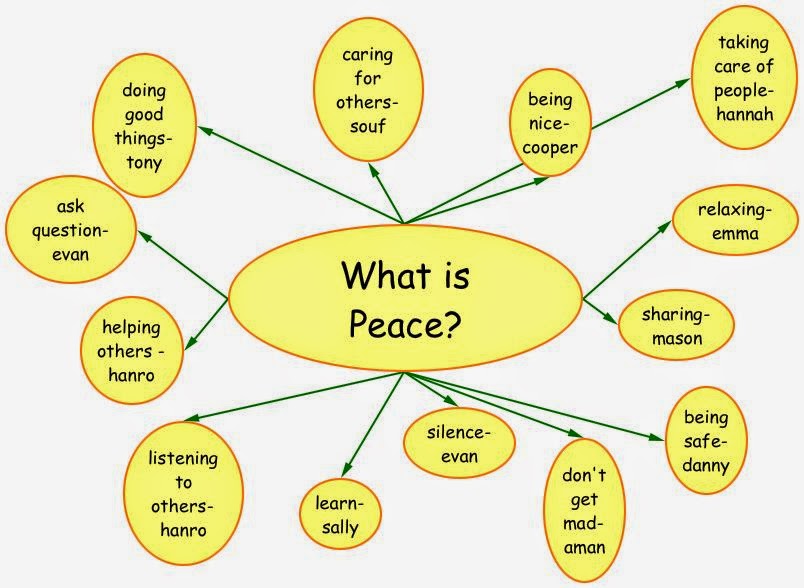
First graders have a very good concept of peace (image from Miss Krug's Our Grade One blog):

 
Some people view peace as the absence of war or violence. Perhaps this view comes to us from  Ancient Greece in the goddess Eirene the goddess of peace, who also celebrates decisive battles that end wars. If we subscribe to this paradigm, we probably are following the axiom "the ends justify the means."

Another high level view of peace is one that focuses on harmony and tranquility that can take the form of an inner state or a state between people. We can say she is always tranquil and peaceful or they have a harmonious marriage.

Peace can be considered as cooperation between people in a social group or culture to maintain a certain level of social order. Keep in mind that slavery existed in the USA during times of peace and for me, slavery does not equal peace.
Liberian Women for Peace


The Global Peace Index (GPI) attempts to identify countries by their level of peacefulness focusing on various formal military measures, prisoners per capita, refugees, wars, etc. 

In the last hundred years, peace has been tightly coupled with the idea of non-violence. So now we have to define what non-violence is and how non-violent  methods contribute towards creating peace.

I'm sure most of you are familiar with the teaching of the Dalai Lama, Mahatma Gandhi, and Martin Luther King Jr. -- all of which emphasis non-violence --another problematic concepts. Defining non-violence is just as hard as defining peace (but I think by now you know how to approach this issue.)

The Dalai Lama offers these words, "Peace can only last where human rights are respected, where the people are fed, and where individuals and nations are free." Of course now we have to figure out what "free" really means. For example, do we include the freedom to harm others in the word free? Or are your freedoms curtailed when they impact my freedoms? How does your pollution impact my freedom?

Peace is often negotiated between groups of people. For example, a family, school, city or state negotiate what they see as peace.

International Alerts writes, "


Monday, May 25, 2026

Rap 151 and 515 on Alcohol at the Gathering

Rap 151

It is a tradition in our family to discourage alcohol use at the Gathering.

We, especially our children, need a safe and sane environment to celebrate in. We respect the alcoholic’s right to drink, but the alcoholic must respect the rights of others to gather in an alcohol-free environment.

The gathering is a prayer and peace sanctuary, not a booze party. Your siblings can help you through it if you wish to stop. Be whole, be healthy, be your true self at Rainbow.

Rap 515

If you are hyper-sensitive to drinkers, don’t become a nuisance to them or to Shanti Sena.

If a drinker is bothering you, bring others along with you and try to use reason; do not grow angry or reactionary.

Many now respected siblings were once where this drinker is. Love them and they will come to the center.

If you are panhandled or otherwise insulted by a drunken individual, say no or leave. If someone has a legitimate problem, help them if you want. If you don’t, tell them to look for someone else.

Sunday, May 24, 2026

Love

The rainbow family is full of love. We shout "we love you" to the sky, to other gathers, to the earth upon which we gently walk.  I have many friends whose children were conceived at the gathering.  We shower love as best we can on people who are unhappy about our presence in their neighborhood. We love all our siblings (brothers, sisters and transgenders), even the ones we do not like all that much.  We love the person who didn't pick up their dog shit, but we want to talk to them about their behavior as well. 

We even have a somewhat sarcastic phrase "loven you" to indicate our concern without being too mushy. With all these types of love floating around, how does love contribute to creating peace? Does the manner in which we love matter or does it matter more how we express our love?

In English we are limited as we have one word for love. The ancient Greeks had four separate words for love:
  • storge - kinship or familiarity
  • philia - friendship
  • eros - romantic and or sexual feelings
  • agape - self-emptying or divine love

Spanish has many words for love:
  • encantar - indicating strong like
  • gustar mucho - indicating strong like
  • querer - to love romantically, to want
  • afición - enthusiasm
  • amado - sweetheart 
  • amor - pure love, romantic love
  • caridad - charity
Love is also an emotion. A very strong and powerful emotion.  How many of you have made decisions based on amar, agape, caridad, eros, and storage? I'm guessing everyone.

For the romantics among us, love is what creates beautiful art, amazing music, and sleepless nights.

For the biologists among us, love is a biological function like hunger or thirst that creates attachments between people, thereby insuring human survival in a dangerous and hostile world.

For the psychologists among us, love is not only a feeling, but a series of actions. 

Unconditional love is a common theme of most of the major belief systems and is one of the often unspoken foundations of participating in the phenomenon commonly called the Rainbow Gathering.

So what does all this have to do with creating a culture of peace?

Well besides being a slogan from the 1960s, using love as a way to create connections strengthens our interpersonal relationships. If we love someone with whom we disagree, we are highly motivated to find a solution that meets the needs of everyone.  If we have no personal attachment to other living beings, then we can more easily ignore their perspective and we often do not care about their  happiness.

Yet loving each of our siblings all the time is challenging. Some of our siblings act out, behave poorly, don't clean up after themselves, steal, fight, or are just downright mean. What then?

Then we muster our agape and our caridad and try to make that connection. We try to befriend our siblings. By finding a connection, we are creating a relationship. It may be storage it may be afición, but if we can love another person in the worst situation, then maybe we can use that relationship to work towards peace.

But to be clear, loving someone does not mean you accept all their actions.

True love is being able to love your siblings while calling them on their bullshit (in a loving manner). 

True love is being able to communicate in a loving way why specific actions are hurting you, the planet, or other living creatures.

True love is a meditative practice we undertake as we deal with the frustrations, interruptions, disappointments and annoyances that fill our lives.

 Let your mantra for this year's gathering be I love all my siblings and this beautiful planet we call home.

Love is the path towards peace.

Friday, May 22, 2026

The Mini-Manual of Gathering Consciousness

The Mini-Manual has been around for decades and has seen some updates from time to time, but it contains all the basic info. This is a great document to make copies of to bring to the gathering. Everyone needs this information and accessing the Internet at a gathering is a tough thing to do.

Find the Mini Manual 2014 edition online.


Prayer for World Peace on Interdependence Day (July 4th)

Circle on July 4
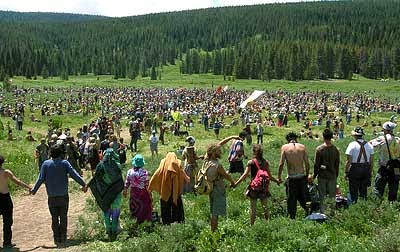
Photo from Colorado 2006 (thanks Solace)

The silent prayer/meditation for world peace is the culmination of our attempts to create a peaceful and harmonious gathering. Starting as the sun rises on the morning of July 4th, the gathering will become silent. As people wake up and get ready for their day, most people respect the silence. As people are so inclined they head to main meadow to pray for world peace, do yoga for world peace, meditate for world peace and all sorts of other mellow and silent manifestations of creating the energy of world peace and the healing of the planet.


 We hold this peace in preparation for the arrival of our children. The children's parade (meet at Kid Village or Dirty Kid Village a few hours before noon if you have kids and want them in the parade) will come into the center of the circle. Please hold the silence until all the children (even the ones at the end of the parade) have made it into the center of the circle. Our children our are future and deserve our respect. Oming/Auming can start when most of the children are in the circle.

 PLEASE SHARE THIS INFORMATION WIDELY.

At some point before breaking the silence we will om/aum. Not a short 1-2 minute om, but a long drawn out 15 minute or 30 minute om/aum. If we are all focused and om together, not in a hurry to get it done, but to be with it in the moment, we can create energy that will change the world.

Each of us has a crucial role to play in this sacred ceremony that is the core of the Annual Rainbow Gathering. This is why I and so many people I know go to the gathering, dig shitters, chop wood and carry water. This is why so many people dedicate so much resources and energy to the gathering. Please if you choose not to participate, please be silent and let those who wish to create a sacred ceremony do so.

Wednesday, May 20, 2026

Creating your vision at the gathering

How to focalize what you want to see at the gathering. 

Depending on what you what to focalize, you may have to arrive early. 

If you want to focalize an art camp, probably arriving a six or seven days after the solstice will work, but if you want to focalize something that requires prime real estate (main boggie pit, handicamp, Medical Camp, etc) you will probably need to land on site within a few days of the site being known. 

This doesn't mean you have to do all the work yourself, but you need to be the person who is there, holding space, talking to everyone and anyone about your vision, making signs to gather workers to help you build your vision, etc. The focalizer is the person who communicates the need. If others agree with the need or you can convince others of the need, then people will join you in manifesting your vision. If no one else agrees, or they think their are more pressing needs, they will go do other things.

From WelcomeHome.org "We don't have leaders in the Rainbow Family, but we do have folks that help us to focus on what we as individuals need to do. It's through the widespread flow of information about our hipstory, our traditions, our processes, and practical gathering info that we as individuals can make informed decisions. That's a lot of what Rainbow is all about, the empowering of individuals within a group of folks. We can all make a difference.

One of the important things to realize is that focalizers aren't in charge. They aren't in control of anything or anyone but themself. People listen to focalizers out of respect, not because they have to. The best focalizers are invisible at a gathering. Many people that consider themselves focalizers are just info-maniacs. Just cause somebody may have a mailing list, or do a newsletter does not mean they are part of the "Rainbow Bureaucracy,"\, and you can turn over your responsibilities as a human being to them."
 

The gathering is co-created by all of us! Don't you want to be one of us?

Friday, May 15, 2026

Sustenance and Safety

One of the foundations of creating peace is making sure people are prepared, in the right mindset, and able to do the hard work that creating peace entails. Sustenance and Safety are the building blocks of peace.

Sustenance takes care of our bodily needs. We can't think well when our blood sugar is crashing or when we are dehydrated. Adequate food and water is a must for all in order to be able to even discuss peace.

One of the most important actions a person can take at a gathering is making sure everyone is eating and drinking plenty of water. This year we will be in the northeast and that generally means moister gatherings and lot's of sweating. One gallon a day of water that has been boiled for 20 minutes or filtered with a 0.2 micron or smaller filter is a must.


When people haven't eaten or are dehydrated they act out. When they are in these conditions for too long, they get sick.  When you combine these issues with over-indulgences, we have a recipe for problems that can impact the entire gathering.

Prevent the problems by making sure you and the people in your vicinity are eating and staying hydrated. Be on the look out for people who look like they aren't getting food and/or water and help them before they start breaking the peace. 

Now for the tough topic: safety.

Safety is a bit harder to come by because what constitutes a feeling of safety is a very subjective and emotional feeling.  To explain what I mean, we'll talk about the estuary by my house.  The salt marsh and estuary have been channelized to prevent flooding and on either bank is a trail. The east side is a paved path that hooks up with bike paths to the north and south. The west side is a dirt road with trees providing shade on a warm day as shown in the image.
The Estuary

People in my neighborhood have very different perspectives on the estuary. Some people view it as a haven for criminals and are afraid to go down there especially after dark. Other people loving taking their kids down to watch the Great Blue Herons and Osprey trying to rustle up a meal.

Now you would think there is some logic as to who feels safe at our estuary and who is scared, but so far I haven't observed any patterns.  I see people with small kids down there watching the sunset and in the early morning many seniors walk their dogs. Then I meet other people in their thirties and forties who are scared to go down without a large group of people because once upon a time someone had a bike stolen (maybe 10 or 15 years ago).

In addition to the herons and hawks at the estuary, one finds the deferentially housed: people who live in tents or throw down a sleeping bag under a bush for the night.  Some people are scared of people with different lifestyles then their own, others exchange pleasantries with everyone. Some people who live in non-portable houses are scared of our unhoused neighbors. Others make friends.

Every time I speak at a community meeting, some people go off the deep end on how dangerous the estuary is and others talk about how it's an asset to the community.  I know that I can't change people's opinions about which is which. Plus trying to address how people feel is tough. Your feelings are neither right nor wrong, they just are.

Low crime rates do not make people feel safe. Community makes us feel safe.

So having said all this, how do we help everyone feel safe at the gathering?

One way we can do this is to treat others the way they would like to be treated -- not the way you would like to be treated.  Try finding gentler voices. Look out for each other in peaceful ways and make sure the people in your vicinity seem comfortable. We all have different levels of tolerance, sensitivity, and fear. Honor that.

If someone looks uncomfortable, they probably are. Introduce yourself. Smile at someone you do not know.  We all feel more comfortable when we are around friends. Share your gathering wisdom. Pay more attention to body language. Learn to pick up vibes from the people around you. If you sense that someone is afraid of a situation, help them to feel comfortable by either staying with them, removing both yourselves from the situation, or talking to the other person about their fears in a supportive way.  Just because the situation is comfortable for you, doesn't mean it's comfortable for everyone.

Honor our differences and our need to be treated accordingly. Help each other on this journey.

Please pay special attention to law enforcement officers. A scared cop is a dangerous cop (remember Wyoming 2008?). Turn down the volume on negative energy by oming instead of cussing when you do not like a situation.

Think about how you would like others to act around your three year-old child and your ninety year-old grandparent and act accordingly.


Tuesday, May 12, 2026

Where Do I Poop?

There have been a few versions of booklets that help gathering participants understand the logistics of the gathering.

Where Do I Poop? is the latest?   Find the full PDF online, print out copies, and distribute when you get to the gathering.

Image of cover of Where Do I Poop?

Monday, May 11, 2026

Rap 451 - Fire Safey


Rap 451 Fire Safety

PLEASE join our consensus: There are no leaders here. We each are responsible and accountable for creating a culture of fire safety. To protect ourselves and the forest, fire safety is vital.

Community Fires Only! Reduce wildfire risk, reduce smoke and build community. Please, no personal fires.

Be safe! Build fires away from tents, trees, and brush. Remove duff (flammable organic matter on the forest floor), and all debris down to the dirt for at least twenty feet around fires and smoking areas. 

Have shovels and water buckets nearby. Control the size of the fire and sparks. Never throw anything into a fire. Never leave a fire unattended. Extinguish by drown-stir-feel = cold to the touch.

Reduce Impact: Only gather/burn dead, down, and dry fuel. Avoid digging large boogie pits as they scar the earth. Preferably build fireplaces/structures above ground, 200 ft away from bodies of water. If you must dig, line pits with rocks/clay to avoid igniting roots. Warning: rocks from wet areas may explode when heated.   

No Fireworks: They are dangerous and illegal in our National Forests.

Wind Danger: Be aware of wind directions and speed, be cautious of wind spreading sparks which may ignite fires.

Vehicles: Avoid leaving vehicles running in parking areas, as this can ignite fires. Do not drive onto dry grass or brush. Heat under the car, sparks, backfiring, or exhaust, can start fires that you won't see - until it's too late. 

Power Tools: Use extreme caution with chainsaws, generators, propane devices and other power equipment, in accordance with forest regs. 

Smoking Safety: 1. Shade 2. Sit. 3. Smoke. Ensure all embers are fully extinguished, dispose of remnants safely, pocket your filters/crutches. Practice safe smoking!

Cooking Safety: Put out grease fires by covering pot/fire with a lid, a fire blanket or if none of those are available, use dirt, not water nor flour.

Substitute LEDs where possible for lanterns, light dancing or fire poi.

      Please take care of family and the forest by being fire safe!

Minimizing LEO Harassment at Gatherings

What is the difference between peacemaking , peace enforcement ...There are things that we can do to minimize the negative impact of LEO (Law Enforcement Officer) presence at gatherings and render them relatively impotent.

First off, every cop that sets foot anywhere in the gathering should have escorts. Escorted cops can't do much damage. However, it's very important that police escorts be done appropriately.  As with everything gathering related, we should have a minimum of three people. If you see someone walking alone with the cops, join in but only refer to each other by "sibling."  No names in front of the LEOs.

I'm sure there are many other ideas floating around, but as someone who has been spending a lot of time walking with cops over many, many years, here is my 2 cents. 

People escorting LEO should not interfere in their actions and keep a safe distance. Who safe is safe?  That varies by years generally.  If they are friendly, have a conversation with them. If not keep your distance. 

Someone should run ahead and yell six-up to warn our family that cops are coming up the trail.

Hopefully, someone has video equipment and is capturing the entire thing on tape, computer chips or whatever. You never know when a calm cop walk will blow up and the camera needs to be working before the blow up.

People doing escorts should not have any outstanding warrants or be carrying anything on their person that would be judged illegal by a court of law.  If you are high, it's not your turn. 

It helps if you have can display a non-confrontational demeanor and remember to walk like Ghandi or Robin Williams.

It's best to have three or more people doing this on each escort, but due to a lack of folks helping with cop watch these last few years, I've spent a lot of time on my own with 6 or 8 cops in the woods - definitely not a great situation and one I don't recommend unless you have a lot of practice under your belts.

If you can carry on a friendly low key conversation with any of the officers, that helps minimize tension.


If anything happens, video, write down details and if someone is arrested, make sure someone knows and will go after them to town and bail them out. If you don't know the person being arrested or their friends, go to INFO and post an announcement, let the INFO crew now and please announce it at main circle.

We all know how hard scouting is and access roads are both a blessing and a curse. They provide ease of access for disabled family and kitchens bringing in supplies in hand carts. Unfortunately they also
allow ease of access for the USFS LEOs.

As we don't know what this year's site will be, there's a couple of things we can do to minimize problems. Keep kitchens and camps off the road. Just cause a road goes through or near the sites, doesn't mean everyone needs to set up there. Explain to people before the gathering, at the front gate, at Welcome Home and when you see them setting up that the folks camped near the road or hanging out there are easy pickens for cops.

If you don't deal well with cops, then please don't. When someone yells six-up, just fade into the woods and let them pass. Engage in passive resistance.

OK Here's my pitch for middle aged + women. I'd love to have a tight crew willing to do cop walks together and even do it naked if we need to. Nothing like some nice cellulite and saggy breasts to take the fight out of the cops. I think middle aged + women make awesome cop walkers.The cops generally aren't threatened, we tend to be good at idle chit chat, and it's a great way to walk off those extra pounds.

Finally, cop watch is not an organized thing. If you see cops walking or driving and they are not being escorted, then tag you're it. If you get tired, try to recruit replacements before you drop out.

And my desperate plea. If someone walking with the cops taps you on the shoulder and asks you to run a message to someone, please take this seriously and do as you are asked - the person you keep out of jail might be your husband, wife, brother or daughter. We need to work together on this. 

Thursday, May 7, 2026

Respect

The gathering of the tribes is dedicated to creating peace on earth and the positive evolution of the planet. Sometimes peace seems so hard to attain, it can be helpful to focus on strategies that create opportunities for peace.  Today's concept is "Respect."

From the beginning, the gathering included concepts of respect. The invite to the first gathering in 1972 started off:

We, who are brothers & sisters, children of God, families of life on earth, friends of nature & of all people, children of humankind calling ourselves Rainbow Family Tribe, humbly invite:
All races, peoples, tribes, communes, men, women, children, individuals -- out of love.
All nations & national leaders -- out of respect
All religions & religious leaders -- out of faith

 If I were authoring the invite today, I would modify it to:
All races, peoples, tribes, communes, humans and other living things -- out of respect and love.

So how then does respect contribute to creating peace?

Peace needs nurturing and dialog to plant its roots and grow.  Peace needs food and water.  If we do not respect the needs of peace and honor those needs, we are doomed to failure.  So how then do we go about creating respect at our gatherings?

When we gather, we are a community with a diversity of backgrounds, religious beliefs, political affiliations, interests, hopes and dreams. Honor that diversity in each of us -- our differences are what make us capable and interesting. Our connections are what make us strong.

The following ideas are commonly shared ideas, I didn't invent them, but I find it helpful to be reminded of them.

Respect is one of the core values in our attempts to create an egalitarian culture. By approaching my family with respect I am laying the roots for a relationship. By treating people the way they wish to be treated, I can connect with others. If I offer respect to another person, that person is more likely to offer respect to me and to others. People who are treated with respect, learn how to treat others with respect.

We are all part of this big, wonderful planet called earth and hence we are all connected. Rather than trying to severe these connections, let's strengthen them. In 1994 at the Wyoming annual gathering, a forest fire occurred at the edge of the gathering up on a ridge. We formed a human bucket line from the creek at the bottom of the meadow to the ridge. None of us could have individually carried enough water up that hill quickly enough to put out that fire. But standing shoulder to shoulder and passing buckets hand to hand, we connected water and fire and extinguished the flames.

Separate issues from people in a respectful manner. When someone is engaging in non-respectful behavior, respect the person enough to explain why the behavior is creating an issue that needs to be addressed.  And always focus on the behavior not the person.

Acknowledge the emotions behind the inappropriate behavior and ask the person if they could refrain from the behavior and share their feelings with us instead. We all do this with our children when we refrain from saying "you're bad" and instead say "you made a poor choice"  or "please use your words to tell your brother why you are upset instead of hitting him."  Why can't we use this same method with adults?  Especially those of us who are children in the bodies of adults.

As the early gatherers (or earlies as they are more commonly known) wrote a long time ago "we are all of us children" as we are just now learning how to live with each other.  Be patient. Some of us learn more quickly and some of us learn less quickly. We all started from different places so we all have different journeys ahead of us. Let's be fellow travelers on this uncharted sea.

Everyone has an opinion and their opinion is no better nor worse than my opinion or your opinion. When we create space for people to freely share their thoughts without fear or judgement, we are creating a space where we respect each other.

Listen. We show our respect to others by listening to what they have to say. We not only listen with our ears, but our hearts, our minds, our souls, and our hands.  When people feel heard, they feel respected. When they feel respected, they are more likely to respect others.

Respect is an important starting point for creating peace.


Wednesday, May 6, 2026

Filtered Drinking Water Fundraiser May 9th on Zoom

Please help support clean water for drinking in the woods!


Event Flyer
Saturday May 9, on https://EverybodysZoom.net

8pm ET Kitchen Sanitation/Water Filtration Tech-Talk

9pm ET Variety Show/Open Mic

Donate: https://gofund.me/1dd8ac1ed

If you would rather bring supplies than donate $$, please reach out to to rainbowwaterfundraiser at gmail dot com and ask for a shopping list.  Be prepared to arrive with purchased items very early as we will need them on or around June 19th.


Saturday, May 2, 2026

On Shanti Sena


Some would say the phrase “Shanti Sena” means “peace army” from Sanskrit and has its roots in Gandhi’s concept of non-violent volunteer based peace keepers. While in gathering lore, some would translate the phrase as peace scene.  No matter the logical translation you wish to put on it, I translate it as being part of a family and looking out for my family in peaceful ways.

In the years of the strife between gatherers and the United States Forest Service Law Enforcement Officers (USFS LEOs), the phrase came to spell trouble for the LEOs and by 2008/2009 many gatherers actually thought the cops were the Shanti Sena (so not true). Because of the many misconceptions floating around, I thought I would take the time to rap about my perspective on keeping the peace at a gathering.

As many of my friends point out, “Shanti Sena” is a verb not a noun. In other words, no one “is” Shanti Sena, but many people “do” Shanti Sena. Most functions at the gathering are verb rather than noun based.

In a culture where individual liberty and communal needs often clash, countless opportunities arise to “do” Shanti Sena and keep the peace.


Before we worry about keeping the peace, we need to define “peace.”  For different people, “peace” takes on different connotations. For some, acting peacefully precludes any acts of physical violence, but yelling is considered peaceful. For others, cussing is not peaceful. For every one hundred gatherers, there are probably ninety different perspectives on what “peace” means. When we gather, I believe that 99.999% of gatherers have every intention of creating peace. We’ll get back to the 0.001% later.  So how then do we create and increase the peace at the gathering and take those skills into the world at large?

In my perspective, the single most important aspect to “doing” Shanti Sena is to be observant. Sure there are big movies that happen and lots of gray haired folks get involved with radios, but most of the time when a big movie happens, the root cause was a failure of each and every one of us to pay attention to the hurt, suffering, pain and/or stress building up around us.  (As an aside, not everyone with a radio has a clue.)

Reality check!  Going to a gathering, especially for the first time, can be very stressful. It’s a crash course in a brand new culture. Learning how to access food and filtered drinking water can be challenging. Being unprepared for the conditions can leave people cold and wet or sitting up by a fire all night to stay warm instead of sleeping. Many people who take medications for chronic conditions often seem to space out on taking their meds, leaving their health further compromised. Dehydration, low blood sugar, and lack of sleep are just a few of the stressors gatherers experience -- add to that doing activities or substances that are new to you. When one small thing goes wrong, people who are stressed out can explode.

Being observant means noticing that some belly is having a hard time or a bad day. Allowing each of us to be our own unique self means not telling other people what to do. Telling people to eat or drink can backfire. So what’s a kind loving brother or sister to do?

Pay attention to the people around you. Notice if they seem to be struggling, are confused or look disoriented. Offer to share your water or an energy bar you might have on you (always good to bring lots of these). Introduce yourself and make a friend. Usually people are more willing to share their troubles with a friend, than someone just trying to fix a problem. Share a song or a joke if the vibe feels right. Sometimes people are in their own head space and don’t want to interact. That’s OK.  You can still stay near them (but not too near) just in case they need help. If it’s two am, please don’t walk away from someone. If someone wants to wander the woods all night, grab a couple of friends and trail after them just in case they need your assistance. 

If someone is using mind altering substances, make sure they are using the buddy system.  If they don't already have a few friends to hang with, please be that person or find someone who can be that person. Multiple times over the years, people who were under the influence wandered away from the main gathering and ended up dying. Please, please, please be your sibling's keeper.

If someone doesn’t have a safe place to sleep, try to hook them up with a camp that can help. If they have small children, Kid Village is a great place. But there are lots of other kind loving camps at the gathering that have the space to squeeze another body into a crowded tent or provide emotional support. If you yourself are new to the gathering (blessings to you for helping others), you can stop by INFO and ask for some advise.

If you find a lost kid, you and a couple of friends should escort the child to Kid Village or INFO. Make sure to take the child up to the kitchen and announce very loudly that you have a lost child. DO NOT JUST DROP THE CHILD OFF AT KID VILLAGE or INFO.

If someone is having a health crisis and is willing, take her/him to CALM (First Aid). Most of the larger kitchens/camps like Om Shalom, Loven Ovens, and Kid Village (to name just a few) have medical people as well. If the person isn’t willing to move, find someone with a radio and medical people will come to your location. If that doesn’t work, send a runner to INFO or CALM with as much information as you have about the situation. By taking care of people’s critical needs before people reach the point of explosion, we create the peace we want to see in the world.

Other times we have conflicts that arise from differing lifestyles. For example in 2002, the gathering site was small and we ended up with Tea Time and Yoga Space next to each other. Talk about a mismatch in energies. Tea Time likes to stay up all night, serve tea and make raucous noise at 3 AM. The Yoga folks are more into silent mediation and mellow energy. Two distinct energies colliding is a classic gathering issue. If we want each camp to be free to express their own vision of peace and love, what to do?  When space permits, it’s always best to camp in an area that meets your vision of what comprises peace and love. So don’t be expecting to sleep in silence until noon every day if you’re camped in Kid Village as kids wake up early.  But ….

As to the 0.001%, when the situation gets a bit crazy, yell “Shanti Sena” and other people will come and assist. With a circle of people, we can try to get a council going with the parties’ involved and where random calm and centered gatherers can sit down and listen to each other.  Keep in mind that sometimes people’s emotions are volatile and getting a council going is difficult at best. Then what?


SITTING down on the sidelines and oming tends to help ground energies. If nothing else, it makes misbehaving people feel a bit silly and often times that breaks up the situation. This doesn’t mean the root cause of the problem is solved, but at least it buys some time and space to work on the issues. I’ve experienced a beautiful voice singing an appropriate song calm everyone down as well. Peaceful, mellow music helps everyone feel better.

Sometimes problems don’t seem resolved at the time. That’s OK. Rainbow magic takes time to work. I’ve sat in circles with people who were full of anger. At some point the primary people stomped out of the circle and didn’t return.  Then a day or two or three later, I ran into those same people again, very happy and peaceful. Rainbow magic doesn’t always have a logical cause and effect.  Sometimes, just hanging out with someone for six hours prevents someone from getting lost in the woods (yes it really happens and if it’s cold out can be a cause of death), drowning in a lake (yes this has happened multiple times at gatherings) or wandering up to the road and getting arrested (you know this happens). Plus you’ve just made a new friend. The more we get to know each other, the more we create community. The more we actively work on creating community, the more we increase the peace.

If you are not able to help when the universe calls you, please, please, please, make sure someone else helps. Ask others for assistance, guide the person to one of the larger kitchens, go to INFO or CALM and let them know what’s going on. Be the change you want to see in the world.

Many years, we have Shanti Sena councils or workshops at the gathering where people who have “done” more Shanti Sena share the lessons they’ve learned with those who have “done” less or no Shanti Sena. As with everything gathering related, we are all of us teachers and all of us students. In the spirit of sharing other ideas on what Shanti Sena is and does, here are some other voices on the subject.


From Welcome Home with links to multiple Shanti Sena Raps by well respected family (must read).
From Niman - a scholarly look

Rap 121


Ask not what the gathering can do for you; ask what you can do for the gathering.

We are our siblings' keepers.

Update June 25

Please spread the word that there is room for 20 more cars off the road at the front gate trailhead plus liots of off the road near the trai...